A commercial door lock upgrade is rarely just about replacing an old lock. It is about controlling who can enter, protecting staff and stock, keeping exits safe, and avoiding the disruption that follows a lost key, staff departure or break-in. For Canberra businesses, property managers and strata teams, the right approach starts with how each door is used – not with the most expensive product on the shelf.
A front entry used by staff, customers and deliveries needs a different solution from a plant-room door, a tenancy door or a fire exit. A qualified locksmith can assess these differences before recommending hardware that suits your premises, security needs and daily workflow.
Start with the risks around each door
Walk through the property and consider what each door protects, who needs access and when they need it. The rear door of a café may be opened repeatedly for deliveries, while an office archive room might only be accessed by two managers. Treating both doors the same can create unnecessary cost or leave a weak point in your security.
Look for common warning signs: keys have been copied without approval, former staff may still have keys, locks are stiff or unreliable, doors do not latch properly, or one key opens far more areas than it should. A lock that still turns is not necessarily a lock that still provides suitable protection.
The door itself matters as much as the cylinder or lock body. A quality commercial lock fitted to a warped door, weak frame or damaged strike plate cannot perform as intended. In some cases, reinforcing the frame, adjusting the door closer or replacing worn hinges is the more useful first step.
Choose the right commercial door lock upgrade
There is no single best lock for every business. The practical choice depends on the level of risk, the number of users and the amount of control you need.
Restricted key systems for stronger key control
Restricted key systems are a sensible option where key copying has become difficult to manage. Their keys can only be duplicated through authorised channels, helping business owners and property managers keep a clear record of who has access.
This does not mean keys can never be lost, but it reduces the chance of an employee or contractor arranging an unauthorised copy at a shopping centre key kiosk. Restricted systems are particularly useful for offices, medical rooms, schools, warehouses, strata common areas and sites with regular staff changes.
For many small businesses, this is the most cost-effective security improvement because it addresses a major problem: keys that continue circulating long after people have left.
Master key systems for layered access
A master key system gives different people access to different areas while allowing selected managers, cleaners or facilities staff to carry fewer keys. For example, a tenant may have a key for their office, a site manager may access all offices on that floor, and a building manager may access common service areas.
The benefit is convenience with structure. The trade-off is that a master key requires careful planning. If it is lost, the impact can be greater than the loss of one standard key. A well-designed system should clearly define access levels and keep records current as tenants and staff change.
Keyless entry for changing teams and flexible hours
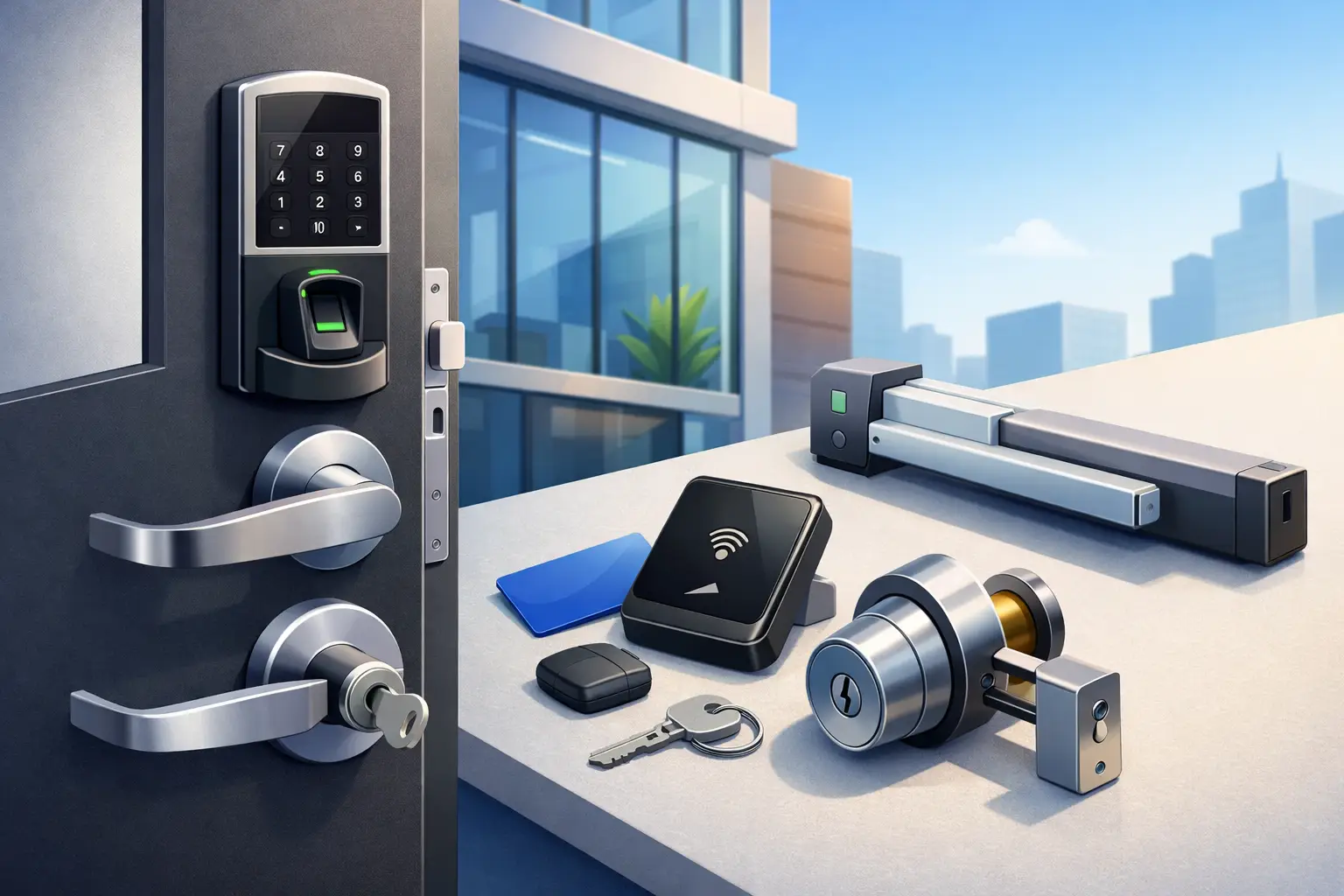
Keyless entry can suit businesses with shift workers, contractors, multiple sites or frequent roster changes. Depending on the system, access may be granted by PIN, card, fob or mobile credential. This can remove the need to collect keys from departing staff and lets an authorised person remove access promptly.
Electronic access is not automatically the right answer for every door. It needs appropriate installation, power considerations and a clear plan for outages, emergency egress and ongoing administration. A simple mechanical restricted key system may be a better fit for a low-traffic storage room, while electronic access can bring real value to a busy office or warehouse.
High-security mechanical locks for exposed doors
External doors, rear entries and doors facing laneways or car parks can benefit from higher-security deadlocks, commercial-grade mortice locks, security plates and protected cylinders. The best option depends on the door construction and whether it must allow free exit at all times.
Do not assume a deadlock is suitable for every commercial door. Fire safety, emergency exit requirements and building use must be considered before changing hardware. This is one reason professional advice matters: security upgrades should make entry harder for intruders without creating a safety issue for people inside.
Do not overlook fire doors and emergency exits
Fire doors and emergency exits are not ordinary doors. Their hardware must allow people to leave safely and must not compromise the door’s fire-rating performance. Adding a lock, drilling a new hole or fitting the wrong closer can create serious compliance and safety problems.
If a fire door is being used as a convenient staff entrance, the better answer may be to improve access control at another entry rather than forcing unsuitable security hardware onto the exit. Where panic hardware, exit devices or monitored doors are needed, have the full arrangement assessed rather than making a piecemeal change.
Rekeying may be smarter than replacement
Not every security concern requires new locks. Rekeying changes the internal key combination so old keys no longer work, while retaining compatible lock hardware. It is often a fast, practical choice after a tenancy change, lost keys, employee departure or handover of a commercial property.
Replacement is usually the better option when the lock is worn, damaged, poorly suited to the door, easy to bypass or unable to support the level of key control you need. A locksmith can advise whether your current cylinders can be rekeyed into a restricted or master key system, which may reduce the cost of a wider upgrade.
Plan for the people who actually use the building
The strongest security plan fails if staff prop open the rear door because the lock is awkward, or if managers share a PIN because the system is too difficult to administer. Good commercial security should be straightforward enough to use correctly under pressure.
Before choosing a system, consider staff turnover, cleaners, delivery drivers, after-hours trades and emergency access. Decide who can approve new keys or credentials, where records will be kept and what happens when a key, fob or code is lost. These small procedures are often more valuable than adding another lock.
For larger sites, it can help to label doors by function and create a simple access schedule. Keep it current. An old access list is a security gap waiting to be found.
When to act quickly
Some upgrades can be planned during normal trading hours. Others should be treated as urgent. Arrange professional help promptly if there has been a break-in or attempted break-in, keys have been stolen, a former employee has left in difficult circumstances, or a lock no longer secures the door reliably.
After forced entry, avoid only repairing the visible damage. Check the lock, door frame, strike plate, hinges and closer together. A quick fix that leaves the same weak point in place can invite a repeat incident.
Night & Day Locksmiths has supported Canberra businesses with commercial locks, restricted keys, master key systems and access solutions since 1979. A site assessment can identify which doors need immediate attention and which improvements can be staged around your budget and operating hours.
A well-planned upgrade gives your team clear access, keeps former keys from becoming an ongoing risk and makes the building harder to target. Start with the door that would cause the most disruption if it failed, then build a security plan that works for the whole premises.