A missing key is rarely just a missing key. For a homeowner, it can mean a late-night rekey. For a business, it can mean uncertainty over who can still enter the office, storeroom or site. The choice between access control versus keys comes down to more than convenience: it affects how quickly you can respond when staff change, keys disappear or your security needs grow.
Traditional keys remain a sensible, dependable option for many properties. Electronic access control can offer much tighter oversight and easier day-to-day management. Neither is automatically the right answer. The better system is the one that matches the people using the premises, the level of risk, and the way the property operates.
Access Control Versus Keys: The Real Difference
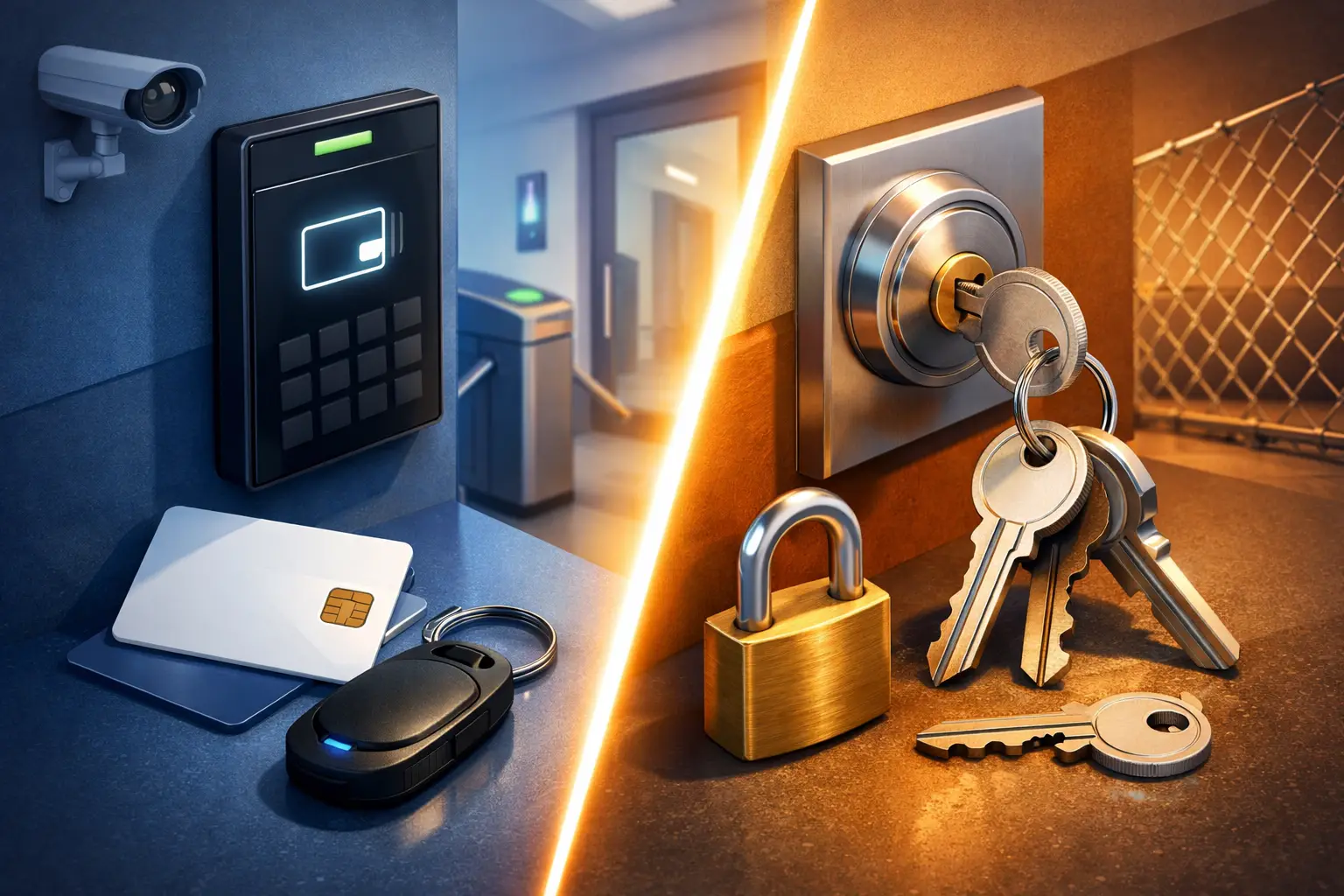
A mechanical key works with a physical lock. You issue the key, the holder uses it, and the lock has no record of when that happened. Quality locks, restricted key systems and master key arrangements can make this model highly secure, but managing access is still largely physical. When a key is lost or not returned, a locksmith may need to rekey or replace cylinders to restore certainty.
Electronic access control replaces or supplements keys with credentials such as swipe cards, fobs, PIN codes, mobile credentials or biometric readers. A credential can usually be added, removed or restricted without changing the lock hardware. Depending on the system, managers can see entry events, set access times and control particular doors from one point.
That difference matters most where access changes often. A family home with two regular occupants has very different needs from a warehouse with shift workers, contractors, cleaners and multiple delivery areas.
When Traditional Keys Are the Better Choice
Keys are not outdated simply because electronic options exist. They are familiar, straightforward and do not depend on software, batteries in credentials or staff learning a new system. For many Canberra homes, a quality deadlock or deadlatch with correctly cut keys is practical security that works every day.
Keys can also suit small businesses with one or two entry points and a stable team. A well-designed restricted key system gives the owner control over duplication, while a master key system can give different people access to only the areas they need. For example, a manager may hold a master key, while staff have keys for the front door and their work area only.
The upfront cost is often lower too. Mechanical locks are generally less expensive to install than a multi-door electronic system, especially where cabling, readers and door hardware are needed. They are also easy to understand in an emergency. If someone has the authorised key, they can enter.
The trade-off is accountability. A key can be copied if it is not restricted, lent to another person or kept after employment ends. You may know how many keys were originally issued, but not always where each one is now. After a lost set of keys, moving house, a tenancy change or a staff departure, rekeying is often the sensible response.
Restricted keys reduce the risk of copies
Not all key systems offer the same protection. Standard house keys can be copied at many key-cutting outlets. Restricted key systems are designed to limit who can authorise duplicates, giving homeowners, property managers and business owners much better control.
This is particularly useful for strata buildings, rentals, offices and sites where several people need entry but the owner wants a clear process for issuing more keys. It does not create an audit trail of every door opening, but it addresses one of the main weaknesses of ordinary keys: uncontrolled duplication.
Where Electronic Access Control Earns Its Keep
Access control is most useful when people, permissions or operating hours change regularly. Rather than collecting a key from every departing employee, a manager can cancel that person’s card, fob, code or mobile credential. A new starter can be granted access only to the doors and times required for their role.
For a medical practice, that might mean reception staff can enter from 7 am while cleaners have access only after hours. For a warehouse, forklift operators may enter the loading area but not the office or stock cage. For a shared commercial building, each tenant can have separate permissions without carrying a large bunch of keys.
The ability to review entry activity is another major benefit. If there is an incident, an access control system may show which credential was presented at a particular door and time. That is useful for investigating unauthorised access, confirming opening procedures or resolving simple questions about who was on site.
Electronic systems can also be more convenient at busy doors. Staff do not need to find the right key from a keyring, and access can be programmed around business hours. Some systems allow remote management, which can help a property manager or owner dealing with an issue away from the premises.
These benefits come with costs and responsibilities. The system needs suitable installation, reliable power arrangements and ongoing administration. Someone must keep permissions current. If every former contractor remains active in the system because nobody reviews the list, the technology will not improve security.
Cost Is More Than the Installation Price
Comparing a lock and an access control reader by purchase price alone can be misleading. A mechanical system may cost less initially, but consider the cost of repeated rekeys, replacement keys, callouts after lost keys and the time spent chasing keys from former staff or tenants.
An access control system may cost more to install, particularly across several doors, but can lower administration costs where turnover is high. Cancelling a credential is generally quicker than replacing a lock cylinder. The savings become more noticeable in larger offices, schools, managed buildings and businesses with contractors coming and going.
On the other hand, electronic access control can be excessive for a single low-risk door used by a small, stable household. Spending should reflect the consequences of unauthorised entry, not the appeal of the latest technology.
Do not overlook door hardware
Security is only as good as the door, frame, strike plate and fitting work around the lock or reader. A sophisticated access control system installed on a weak door may create a false sense of security. Likewise, a quality deadlock cannot compensate for a damaged frame or poorly aligned door.
A proper site assessment should look at how each door is used, whether it is fire-rated, how people exit in an emergency, and whether it needs to remain secure during a power interruption. These details are particularly important for commercial premises, apartment common areas and sites with public access.
A Practical Way to Choose
Start by asking how often access changes. If the same small group uses the property for years, keys or a restricted key system may be the cleanest solution. If staff, tenants, contractors or service providers change frequently, electronic access control is usually easier to manage.
Next, consider whether you need records. If you need to know who entered certain areas and when, keys cannot provide that information. If physical security is the priority but entry records are unnecessary, high-quality mechanical locks may be enough.
Then look at the number of doors and users. One front door is different from a site with a reception entrance, staff door, server room, stock area, loading dock and car park gate. Larger systems often benefit from a mix: access control on critical or high-traffic doors, and restricted mechanical keys for lower-risk areas, cupboards or emergency backup.
Finally, think about who will manage the system. Access control is most effective when one person or team owns the process of adding, removing and reviewing credentials. For a small operation without that capacity, a restricted key system can be simpler and more reliable.
Why a Hybrid System Often Makes Sense
The decision does not have to be keys or access control everywhere. Many properties are best served by both. An office might use electronic credentials at external doors and sensitive rooms, while mechanical restricted keys secure plant rooms, cabinets and backup access points. A home may have keyless entry at the main door while retaining quality keyed locks on gates or sheds.
A hybrid arrangement gives convenience where it matters most without adding unnecessary complexity or cost. It can also provide a sensible fallback if an electronic component needs servicing. The key is to plan the system as a whole, rather than adding products door by door without considering who needs access and why.
For property owners and managers, the most useful question is not which option is newer. It is whether your current arrangement still gives you confidence after a key is lost, a tenant leaves or a staff member finishes up. A licensed locksmith can assess the doors, risks and daily routines on site, then recommend a practical combination that protects the property without making access harder than it needs to be.