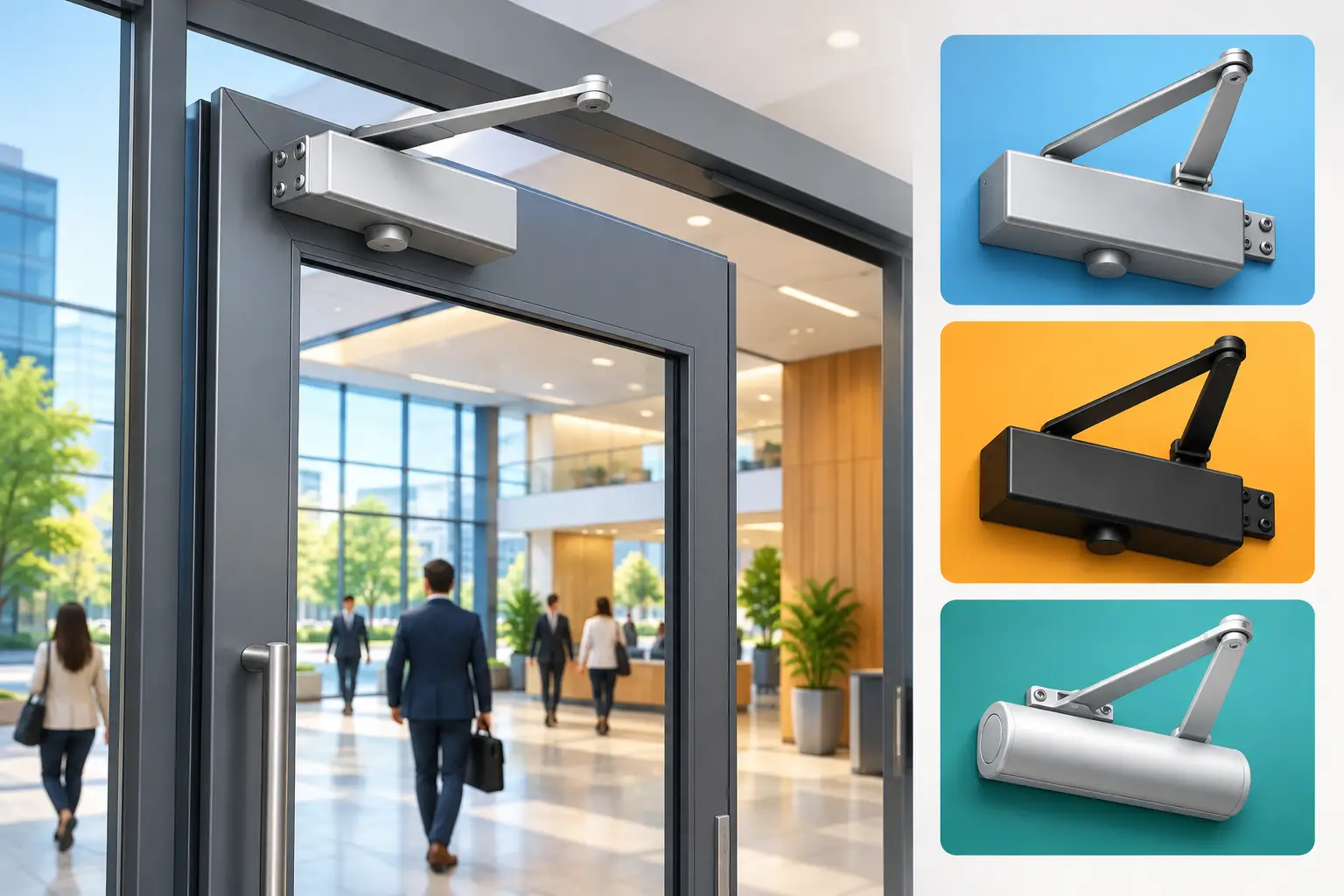
A door that slams, drifts open or needs a shoulder to close is more than an annoyance. It can compromise security, damage the frame, disrupt customers and create a fire-safety concern. The best commercial door closers bring a door back to its latch reliably, quietly and at a controlled speed – even after hundreds of uses each day.
For an office, shop, warehouse, medical practice or strata property, the right closer depends on the door itself and how people use it. The cheapest unit may work on a light internal door, but it is rarely a sensible choice for a busy entry, a heavy fire door or an exposed external doorway. Getting the specification and installation right from the start saves repeat repairs and avoids a weak point in your building security.
What makes a commercial door closer a good choice?
A commercial door closer uses a spring and hydraulic control to close a hinged door after opening. The spring supplies the closing force; the hydraulic system controls how fast the door travels. A quality closer should shut the door firmly enough for the latch to engage without slamming people, fingers or trolleys.
The best option is not necessarily the strongest one. Too much closing force can make a door difficult for staff, customers and visitors to open. Too little force leaves it ajar, especially when wind pressure, worn hinges or building air pressure are working against it. The aim is controlled, repeatable operation that suits the door, its location and its users.
Look beyond the closer body as well. A proper commercial installation considers the hinges, latch, strike plate, frame condition and weather seals. A new closer cannot compensate for a misaligned door or a latch that is already binding.
Best commercial door closers by application
Overhead rack-and-pinion closers
Overhead rack-and-pinion closers are the familiar units fitted at the top of the door or frame, usually with an arm visible on the opening side. They are a practical choice for many offices, retail premises, schools, common areas and internal commercial doors.
They are generally economical to service, available in a wide range of power sizes and straightforward to adjust when fitted correctly. For standard commercial doors with regular traffic, this is often the most sensible format. The trade-off is appearance: the body and arm are visible, which may not suit a premium fit-out or a heritage-style entrance.
Cam-action closers
Cam-action closers use a different mechanism to reduce opening resistance. They can be easier to open while still providing enough closing power at the end of the cycle. This makes them worth considering where accessibility matters, such as health settings, public buildings and premises frequented by older customers or people using mobility aids.
They are often more expensive than a basic rack-and-pinion closer. However, reduced effort can be a worthwhile investment where a heavy door must remain easy to use. Correct configuration remains essential, particularly on fire-rated doors.
Concealed overhead closers
Concealed closers are installed in the door leaf or frame, leaving little visible hardware when the door is closed. They suit professional offices, high-end retail spaces and buildings where a clean finish matters.
Their discreet appearance comes with a practical consideration: access for installation and future maintenance can be more involved. They should be selected early in a new build or refurbishment, rather than treated as an afterthought once the doors are installed.
Floor springs
Floor springs sit below the door in a floor box and are commonly used with glass doors, aluminium shopfronts and heavier pivoting doors. They can handle demanding applications and provide a tidy result, particularly where an overhead arm would look out of place.
They need careful installation, accurate door alignment and protection from water ingress. Replacing or repairing one can also involve more work than an overhead closer, so the quality of the original product and installation matters greatly.
Match the closer to the door, not just the doorway
Before choosing a closer, assess the door’s weight, width, material and swing. A narrow solid-core timber door does not place the same load on a closer as a wide glazed aluminium entrance door. Steel doors, doors with large glass panels and doors exposed to wind commonly require more closing force and better quality hardware.
Commercial closers are often rated by power size, with EN 1154 ratings commonly used as a guide. Higher ratings generally provide more closing force. Adjustable models can be useful because they allow a locksmith to fine-tune the closer after fitting. Adjustment has limits, though. A unit that is fundamentally undersized for the door will wear prematurely and may never close it consistently.
Traffic level is equally important. A staffroom door used a few times each day has very different demands from a shop entrance opening continuously through trading hours. For high-traffic doors, choose a closer designed and tested for frequent cycles. It costs more upfront but is less likely to leak, lose adjustment or fail when the premises are busiest.
External doors deserve special attention. Canberra weather can bring strong winds and major temperature changes, both of which affect door operation. Wind pressure can prevent latching or cause a door to slam. A closer with effective backcheck and properly set closing speeds provides greater control, but may still need support from suitable weather seals, hinges and door stops.
Fire doors need compatible hardware
A fire door only performs as intended when its components work together. The door closer is not an optional extra on a fire door: it must close the door fully into the frame and engage the latch. A fire door wedged open, or one that stops short of latching, can allow smoke and fire to travel through a building.
Do not fit a closer based on appearance alone. Check the door’s fire-rating requirements, the hardware approvals and the manufacturer’s installation instructions. In many settings, the door assembly must also meet relevant National Construction Code requirements and site-specific fire regulations.
Hold-open devices require particular care. A standard mechanical hold-open arm is generally not appropriate for a fire door unless the door’s approved arrangement allows it. Where a fire door needs to stay open for daily access, an approved electromagnetic hold-open system connected to the fire system may be required so it releases when there is an alarm. This is a situation where professional advice is far safer than a guess.
The adjustments that make a closer work properly
Even the best commercial door closer will perform poorly if it is badly adjusted. Most quality closers allow a technician to set closing speed, latch speed and backcheck.
Closing speed controls the main travel from fully open towards closed. It should be steady, not hurried. Latch speed controls the final few degrees where the latch engages. This usually needs enough force to overcome seals and catch the latch, but not so much that the door bangs. Backcheck provides resistance when a door is thrown open, helping protect walls, handles and the closer itself.
Do not keep turning adjustment valves in an attempt to solve every issue. A door that will not latch may have loose hinges, a damaged strike plate, a warped leaf, failing seals or air-pressure problems. Over-adjusting the closer can make the door harder to open and accelerate wear. If oil is leaking from the body, the closer is often nearing the end of its serviceable life and adjustment will not fix the underlying fault.
A practical buying checklist
When comparing commercial closers, confirm these points before approving the job:
- The closer’s power rating suits the door’s width, weight and use.
- It is suitable for the number of opening cycles expected each day.
- It has adjustable closing, latch and backcheck control where needed.
- Its fixing method suits the door and frame material.
- It is compatible with fire-door requirements, access needs and any electronic hold-open system.
- The finish, arm type and mounting position suit the building’s appearance and clearance requirements.
A warranty is helpful, but it should not be the only measure of quality. A long warranty has limited value if the closer is undersized, improperly fitted or used on a door it was never designed to control.
When to repair and when to replace
A closer may only need adjustment if the door has gradually begun closing too slowly or too quickly. Loose screws, arm wear or hinge movement can often be corrected before major damage occurs. Early attention is especially worthwhile on shared entrances, where a failed closer can leave the entire building less secure.
Replacement is usually the better option when hydraulic oil is leaking, the closer cannot retain its settings, the arm is badly worn, or the unit has been repeatedly forced beyond its opening limit. If the door has changed – for example, new seals, access-control hardware or glazing have been added – reassess the closer specification rather than fitting the same model again.
For Canberra businesses and property managers, a licensed locksmith can inspect the full door assembly, recommend a suitable closer and fit it so the lock and latch work as intended. Night & Day Locksmiths can also help where a failed closer is affecting access, security or a fire-door arrangement.
A commercial door should close without anyone having to think about it. If yours is slamming, sticking or being left open, arranging a proper inspection now is a simple way to protect the people and property on the other side.