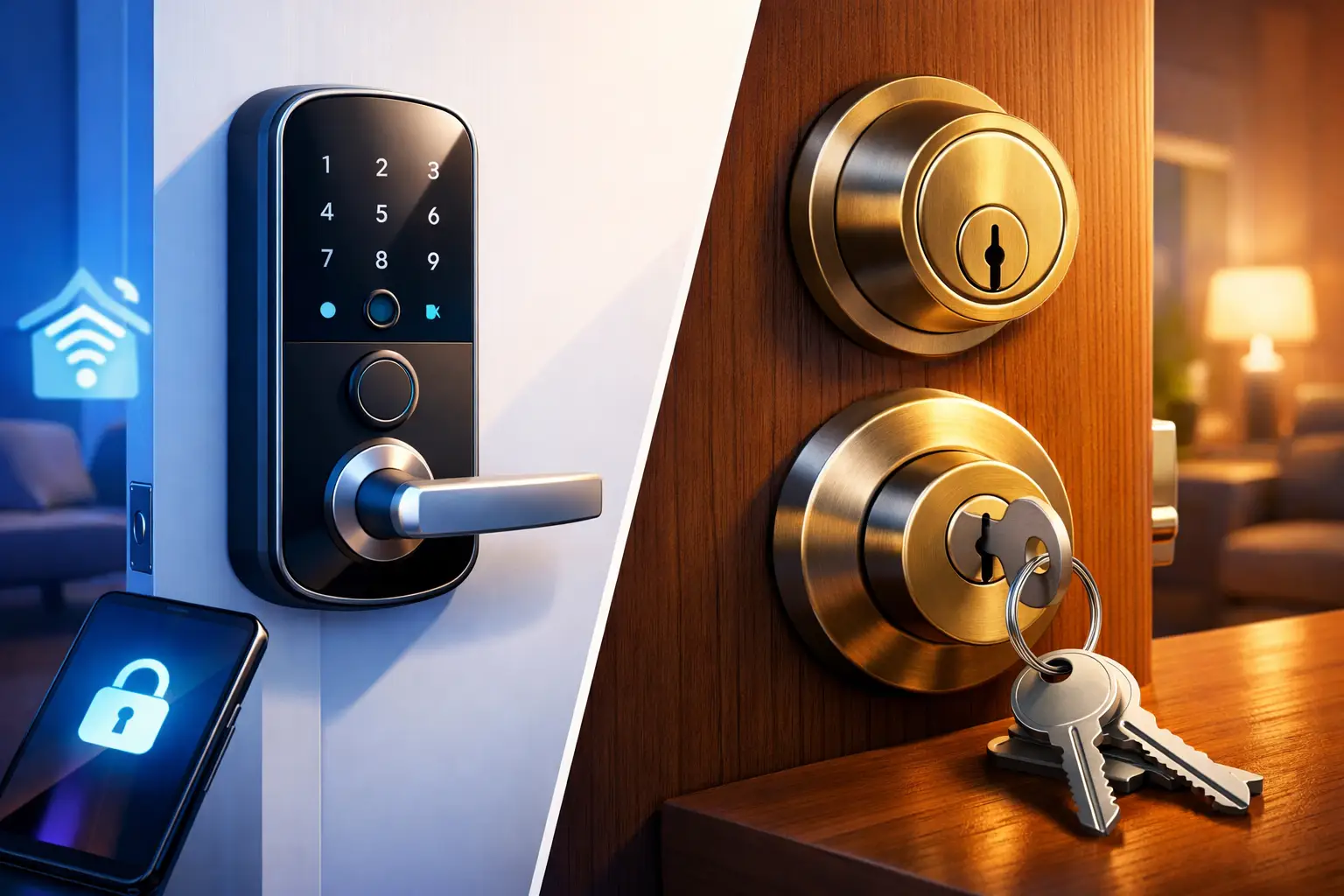
A key left with a neighbour, a code shared with a cleaner, a teenager arriving home after school – the everyday reality of access is why smart locks versus deadbolts is not a simple security question. The right choice depends on your door, who needs access, how the property is used and whether convenience adds genuine value rather than another thing to manage.
A traditional deadbolt remains one of the most trusted ways to secure a hinged external door. A quality smart lock can add controlled, keyless entry and a clear record of who has come and gone. In many cases, though, the best answer is not one or the other: it is a suitable deadbolt mechanism with smart access features, installed correctly by a locksmith.
Smart locks versus deadbolts: the key difference
A deadbolt is a locking mechanism. When engaged, its solid bolt extends into the door frame and resists being pushed back without the correct key or thumbturn. Unlike a basic spring latch, it is designed to provide a higher level of physical security on external doors.
A smart lock is operated electronically. Depending on the model, it may use a PIN code, mobile app, key fob, fingerprint reader or remote access. Some smart locks replace the entire lock, while others operate an existing compatible deadbolt from the inside of the door.
That distinction matters. Not every smart lock offers the same physical strength, and not every deadbolt can be converted into a smart system. Product quality, door construction, strike plate strength and installation all affect the outcome. A well-fitted lock on a sound door is more useful than an expensive product fitted to a loose frame or misaligned latch.
When a traditional deadbolt is the better choice
For many Canberra homes, a quality keyed deadbolt is a practical, dependable option. It has no batteries, no app settings and no connection requirements. You use a key, and the lock works the same way during a power outage, after a software update or when your mobile is flat.
Deadbolts particularly suit homeowners who want straightforward physical security without managing multiple users. They are also a sensible option for side doors, garages, storage areas and other entrances that do not need frequent shared access.
There is a simplicity to a mechanical lock that should not be overlooked. Fewer electronic components can mean fewer potential points of failure. If a key is lost, you can have the lock rekeyed or replaced. If you move into a property, changing or rekeying external locks gives you certainty about who may still hold a key.
The trade-off is convenience. Every authorised person needs a key, and keys can be copied, misplaced or not returned when a tenant, contractor or staff member leaves. With standard keys, there is no easy way to know who entered or when.
Where smart locks make sense
Smart locks are useful where access changes regularly. A family with older children, a busy household with cleaners or tradespeople, a managed rental property, or a small office can benefit from codes or digital credentials instead of extra keys.
The strongest advantage is control. Rather than collecting a key after work is completed, you can issue an access code for a limited period and remove it when it is no longer needed. Some systems also provide entry activity records, which can be useful for property managers and business owners responsible for multiple people coming and going.
Smart locks can also remove a common stress point: getting locked out because the keys are inside. A PIN pad or approved mobile credential gives residents another way to enter, provided the system has been set up properly and users know what to do if a battery runs low.
For a business, keyless entry can reduce the number of physical keys in circulation. However, a smart lock is not automatically a complete commercial access-control system. Larger sites, restricted areas, staff turnover and audit requirements may call for a more tailored solution, such as managed access control or a master key system.
Security is more than the lock on the door
The question is not simply whether electronic or mechanical locks are safer. Security comes from the complete installation.
A lock needs to suit the door material, thickness and handing. The bolt must enter a properly reinforced frame, and the strike plate should be firmly secured. A warped timber door, damaged frame or excessive gap around the door can undermine even a high-quality lock.
With smart products, consider the electronic side as well. Use a unique app password, enable available account security settings and remove old users promptly. Avoid sharing one code with everyone in the household or workplace. Individual codes make it easier to identify access and cancel it without disrupting other users.
Choose a lock with a practical backup method. This may be a mechanical key override, emergency power contact or another manufacturer-approved option. Know where the backup key is kept and make sure the people who need access understand the process. The point of keyless entry is convenience, not being stranded at the front door when the battery warning was ignored.
Battery, power and reliability considerations
Most residential smart locks run on batteries, not mains power. The lock will generally give low-battery warnings well before it stops operating, but those alerts only help if someone notices them and acts.
Set a reminder to check batteries, particularly before a holiday period or if the property will be vacant. Use the battery type recommended by the manufacturer and do not mix old and new batteries. Keep the mechanical override key accessible to a trusted person, rather than hidden outside near the door.
A quality mechanical deadbolt avoids battery maintenance, but its keys still need managing. Bent keys, worn cylinders and poorly duplicated keys can create their own reliability issues. Whichever option you choose, periodic inspection is worthwhile. If the key sticks, the bolt drags or the smart lock sounds strained, address it early instead of forcing the mechanism.
Consider who uses the door
A home with one or two adults may have very different needs from a household with children, elderly relatives and regular service providers. A keypad can be easier for someone who struggles with small keys, while others may prefer the familiarity of a conventional lock.
Renters should check with the owner or property manager before changing hardware. A lock change may be permitted or required in certain circumstances, but altering the door or fitting a smart lock without approval can create a dispute at the end of a tenancy. It is also worth considering what happens when you move out: can the original hardware be reinstated, and who controls any app account or access history?
For strata properties, apartments and offices, fire safety and egress must come first. Occupants must be able to leave safely from inside without needing a key, code or mobile. Building requirements and body corporate rules can affect what may be fitted to common-entry doors, so seek proper advice before purchasing hardware.
Questions to ask before choosing a lock
Before buying either option, look at the practical details rather than just the features on the box:
- Is the door solid, aligned and suitable for the selected lock?
- Does the lock provide the level of physical security needed for that entrance?
- Who needs access now, and how often will that list change?
- Is there a reliable backup entry method if batteries fail or a phone is unavailable?
- Can everyone exit safely and easily from inside the property?
- Will the lock meet landlord, strata, insurance or workplace requirements?
These questions often make the decision clearer. A rear door used only by the household may be best served by a conventional deadbolt. A front door used by family members, contractors and guests may justify a smart lock with individual codes. A commercial premises may need a solution that goes beyond either a basic consumer smart lock or a single deadbolt.
Professional fitting protects the investment
Lock hardware is only as effective as its installation. Smart locks may need accurate door preparation, correct handing, secure fitting and careful setup of the electronic functions. Deadbolts require precise alignment so the bolt throws cleanly into the frame without pressure on the mechanism.
A fully licensed locksmith can assess the door, recommend compatible hardware and check for weaknesses around the frame, hinges and strike plate. For established homes, this can prevent the common problem of choosing a lock first and discovering later that the door is not suitable without modifications.
Night & Day Locksmiths has supported Canberra homes and businesses since 1979, with practical advice and mobile locksmith assistance when a lock needs to be installed, repaired, rekeyed or replaced.
Choose the lock that makes daily access easier without compromising physical security or safe exit. If the door, users or property arrangements make the decision less clear, an on-site assessment is usually the quickest way to get it right the first time.