
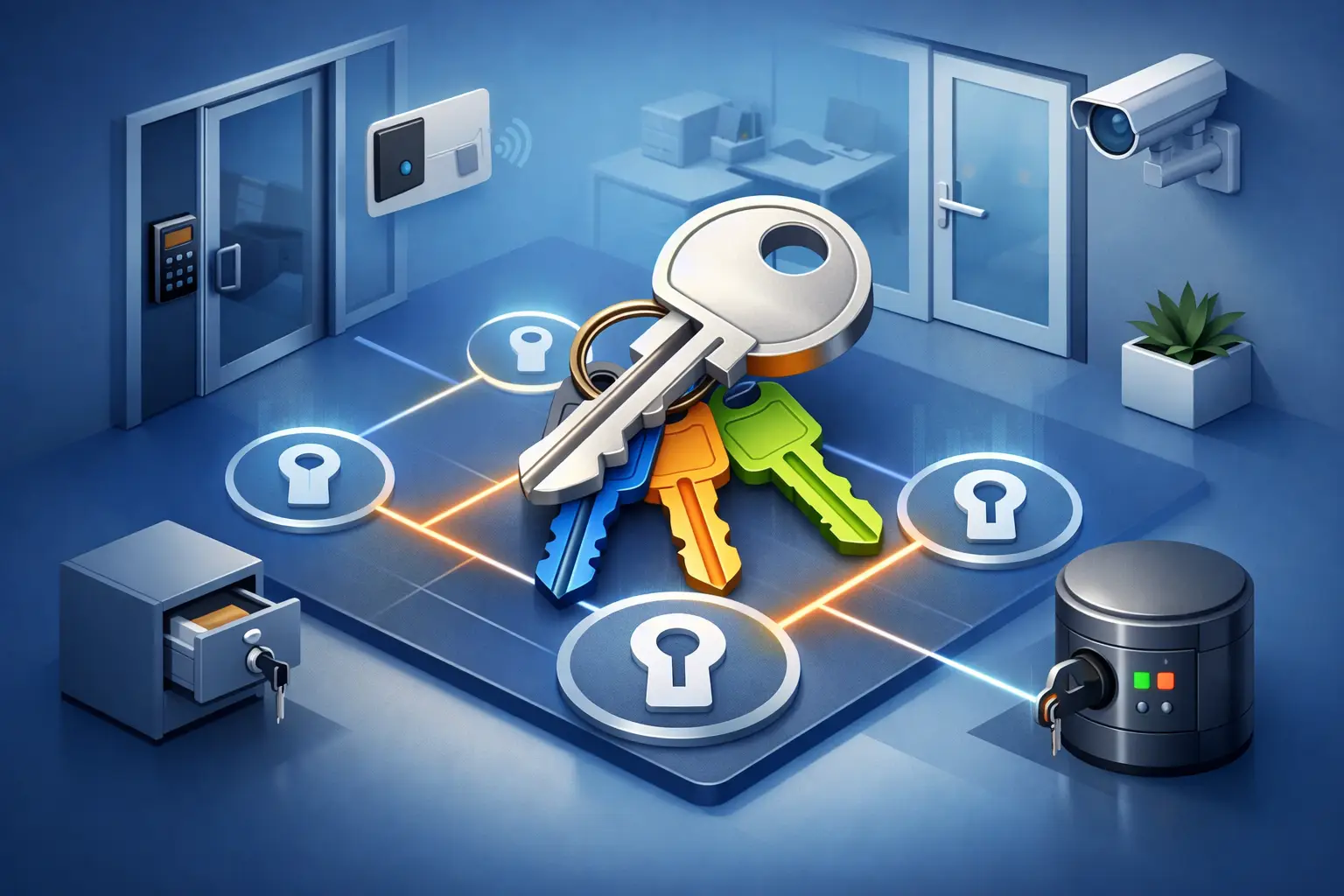
A lost office key should not leave every door exposed, and a manager should not need a heavy keyring to move through their own workplace. A master key system for office access gives each person the entry they need, while keeping higher-risk areas restricted to the right people. For Canberra businesses, it is a practical way to improve day-to-day security without making work harder.
The best systems are planned around how your premises actually operate. That means considering staff roles, visitor areas, contractors, shared tenancies and the rooms that contain sensitive information, stock or equipment. A qualified locksmith can design the key hierarchy, supply compatible commercial locks and make sure the system remains manageable as your business changes.
What is a master key system for office security?
A master key system uses specially configured locks and keys so that different keys open different doors, while nominated keys can open a wider group of doors. It is not one key that opens everything. It is a structured access plan.
For example, an employee may have a key for the front entrance, their work area and shared facilities. Their team leader may also access the stationery store and staff room. A facilities manager may carry a master key for most internal doors, while a director or security contact holds a grand master key that can access the whole site.
The hierarchy is tailored to the building and the people who use it. In a small office, this could be as simple as two access levels. In a multi-floor premises, medical practice, warehouse or strata-managed commercial property, it may include several departments, tenancy areas and management levels.
Why offices benefit from planned key control
Many workplaces begin with standard locks and duplicated keys. Over time, a spare key is handed to a former employee, copied without approval or left with a contractor. No one is completely sure how many keys are in circulation. That is where security and accountability start to slip.
A properly designed master key system reduces unnecessary access without slowing down authorised staff. It also makes the response to staff changes clearer. When someone changes roles or leaves the business, you can identify which access they had and decide whether a rekey is required.
There is also an operational benefit. Cleaners, maintenance teams and emergency contacts can be given access to only the areas required for their job. The person opening the office in the morning does not need keys to the server room, records archive or secure stock cupboard simply because their keyring has grown over time.
For property managers, the same logic applies across common areas, plant rooms, bins, storage spaces and individual tenancies. Controlled access helps protect residents, tenants and maintenance staff while reducing the number of keys needed for routine work.
Start with doors, people and risk
The right system is designed before locks are installed. Start by walking through the premises and separating doors into practical groups. Public entry doors, staff-only rooms, private offices, meeting rooms, IT rooms, records storage, medication cabinets, workshops and high-value stock areas should not automatically have the same access level.
Then consider who genuinely needs entry. The question is not who might need access one day. It is who needs it to do their job safely and efficiently. Giving every employee access to every room is convenient until a key is lost, a dispute arises or confidential material goes missing.
It is also worth planning for the less obvious users. Think about cleaners, alarm technicians, trades, landlords, after-hours managers and emergency contacts. They may need access at a particular time, but not permanent access to the entire premises.
A good locksmith will also inspect the doors themselves. A quality cylinder cannot compensate for a weak door frame, worn lock body, loose strike plate or unsuitable fire-door hardware. In some offices, improving the locking hardware and door security is as important as setting up the key hierarchy.
Choose the right level of restriction
Not every master key system provides the same control. Standard systems can be suitable for low-risk internal areas, especially in small businesses with stable teams. They are often a cost-effective choice, but ordinary keys may be easier to copy if they are not controlled carefully.
Restricted key systems offer stronger key control. Keys can only be duplicated by authorised channels, usually with approval from the nominated business contact. This is valuable where staff turnover is common, keys are issued across multiple teams, or the office holds client files, expensive equipment or sensitive records.
Restricted keys do not remove the need for good procedures. A business still needs to record who has keys, recover them when employment ends and act quickly if one goes missing. However, they reduce the chance that an unauthorised copy is quietly made at a shopping centre kiosk or by an unknown third party.
Electronic access control may be the better fit for some doors. Cards, fobs and mobile credentials can be cancelled without changing a lock, which is useful for larger workplaces or frequent staff movement. The trade-off is a higher upfront cost, ongoing system management and reliance on power, hardware and administration. Many offices use a combined approach: electronic access at main entries and physical restricted keys for selected internal doors or backup access.
Keep the system simple enough to manage
The most secure system is not always the most complicated one. Too many levels can confuse staff, create delays and lead to workarounds such as propping doors open. Keep the hierarchy clear, with each level tied to a genuine role.
Nominate one or two people to approve key issue and duplication. Maintain a key register that records the key number, holder, date issued, areas it opens and date returned. Avoid putting the business name or office address on key tags. If keys are found or stolen, that information makes them more useful to the wrong person.
Store spare keys in a secure key cabinet rather than an unlocked desk drawer. If a master key is needed for emergencies, limit access to it and document each use. For larger sites, a sign-out process can provide a clear record when keys are taken by contractors or after-hours staff.
Staff should also know what to do when a key goes missing. Reporting it immediately is not about blame. It allows the business to assess what the key can access and decide whether a cylinder should be rekeyed before the risk becomes a problem.
Plan for changes before they become urgent
Offices change more often than most key systems do. Teams expand, departments move, a tenant takes an extra suite or a former storage room becomes an IT room. A flexible design allows locks to be rekeyed or access groups adjusted without replacing every lock on site.
Rekeying is often the sensible response after a lost key, staff departure or tenancy change. It changes the lock’s internal combination so old keys no longer work, while preserving the existing hardware where appropriate. It is generally more economical than replacing every lock, but it depends on the condition and type of the cylinder.
If keys have been copied widely or no accurate records exist, a broader reset may be the safer choice. This can involve rekeying multiple doors, introducing restricted keys and starting a new register. It is a disruption worth considering when the alternative is continuing with unknown access.
When to call a commercial locksmith
A commercial locksmith can assess your current locks, identify weak points and build a master key plan that matches the way your office runs. They can also advise whether your doors need upgraded hardware, restricted cylinders, fire-door compliant locks or a combination of mechanical and electronic access.
For businesses that need help quickly, speed matters too. A damaged lock, missing master key or staff lockout can interrupt trading and leave premises vulnerable. Night & Day Locksmiths provides licensed commercial locksmith support across Canberra, including urgent lock repairs, rekeying and planned office security upgrades.
A well-designed system should make access feel ordinary: the right person opens the right door, every time. That quiet reliability is exactly what good office security is meant to provide.